

Rooftop Solar Permitting Reform
COST CONTROLCOST DISTRIBUTIONCUSTOMER AGENCY
Last Updated October 29, 2026
AT-A-GLANCE
IMPACT TIME HORIZON
Short-term (0–2 Years)
POTENTIAL COST SAVINGS
Medium
CONTEXT AND BACKGROUND
Permitting reforms for rooftop solar systems can help more households lower their energy bills by decreasing the cost, complexity, and installation time of these systems. Complicated permitting and inspection processes are a major driver of high "soft costs" for rooftop solar projects that are passed down to households and contribute to project delays and cancellations. States can adopt many permitting reforms to address these barriers, such as automated permitting platforms, third-party plan review, remote inspections, building code reforms, and limits on homeowners' association (HOA) restrictions. Importantly, many of these reforms can also make it easier for households to install battery storage systems. Battery storage offers valuable resilience benefits and can deliver cost savings in some cases, such as through participation in virtual power plants. However, because affordability is not its primary benefit, this policy focuses on rooftop solar.
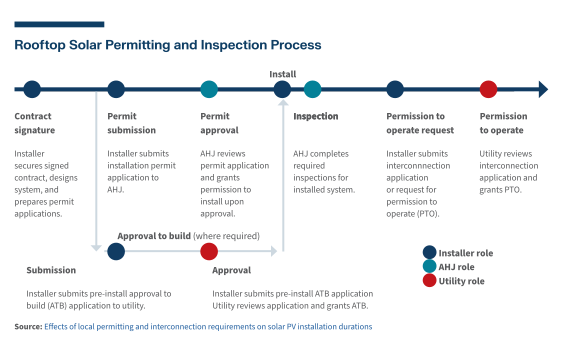
The graphic below shows the many steps that must be completed after a customer signs a contract and before their rooftop solar system can begin operating. However, the reforms outlined here are targeted at the permitting and inspection phases navigated by installers and authorities having jurisdiction (AHJs).1 On average, the permitting and inspection phases for rooftop solar projects take 29 days (excluding installation time), but could take as little as 1 day or up to 97 days. Variation in requirements across jurisdictions, overburdened local officials, lengthy review timelines, and rules unrelated to health or safety increase the complexity and cost of this process.
In the United States, soft costs such as installer labor, permits, inspections, and paperwork make up 60%–78% of the total installed cost of rooftop solar systems.2 Permitting delays are a major driver of project cancellations, and the expense of these project cancellations also contribute to high soft costs. For example, a 2022 study from the National Laboratory of the Rockies (NLR) estimated that cancellation costs alone may account for 25% of total rooftop solar soft costs. By modernizing permitting processes, states can reduce unnecessary costs, decrease deployment timelines, and increase adoption of rooftop solar systems, enabling more households to benefit from lower energy bills.

Impact Time Horizon
How long it typically takes for changes to materialize in utility behavior or customer bills
SHORT-TERM (0–2 YEARS)
These reforms can be implemented quickly, leading to lower installation costs and energy savings. For example, NLR found that most jurisdictions fully adopted SolarAPP+ within a few months.

Potential Cost Savings
The level of cost savings that can reasonably be expected to result from this policy
medium
Cost savings will vary state-to-state, but these reforms deliver meaningful cost savings in two ways. First, they can directly reduce the installation cost of rooftop solar systems by streamlining permitting processes and reducing project cancellations. For example, NLR found that SolarAPP+ reduced rooftop solar installation costs by about 7.5%, or $1,200, for a 6 kW system, and other platforms may provide similar benefits. Second, lower installation costs can increase deployment of rooftop solar, delivering cost savings to customers. Rooftop solar savings will vary state-to-state, but RMI estimates that households with rooftop solar can save over $400 annually on average over the lifetime of their rooftop solar system. Households that finance rooftop solar systems can experience positive cash flow immediately if their monthly bill savings exceed their monthly loan payments.

Target Cost Drivers
The policy can help to ease customer cost pressures created by these drivers
Aging grid infrastructureFuel price volatilityExtreme weather/wildfiresLoad growthMisaligned utility incentives
Because individual households with rooftop solar and battery storage systems can experience bill savings, this policy can address overall affordability rather than targeting specific drivers.

Legislative Design & Implementation Considerations
Legislative approaches will differ state-to-state but can include the following actions to reform rooftop solar permitting and inspection processes:
AUTOMATED PERMITTING PLATFORMS
Automated permitting platforms allow installers to upload system specifications to a software platform and obtain instant permit approvals for code-compliant systems. States can require the use of these platforms, and they may create a statewide platform or utilize equivalent software like NLR's SolarAPP+. States may also consider reducing or eliminating permit fees if permits are issued automatically using these platforms.
THIRD-PARTY PLAN REVIEW
States can allow third-party professionals to review permit applications. Qualified third parties may be able to review permit applications faster than local officials with limited capacity. The state or local jurisdictions can establish the standards to qualify as a third-party reviewer and allow third-party reviewers to use automated permitting platforms.
REMOTE INSPECTIONS
States can allow or require the use of remote inspections by AHJs and/or qualified third parties. Similar to plan review, states or local jurisdictions can establish the standards to qualify as a third-party inspector. Remote inspections can shorten timelines while ensuring installations are safe — the National Fire Protection Agency has a standard for remote inspections, and the International Code Council has recommended best practices.
BUILDING CODE REFORMS
Differences between neighboring jurisdictions' building codes can delay rooftop solar projects by adding complexity to the scoping and installation process. Such differences can increase costs by requiring installers to navigate different rules, redesign projects, or use different equipment across jurisdictions. States can modernize state-level building codes, limit local amendments or restrictions related to rooftop solar systems, incentivize adoption of local codes that remove unnecessary limitations, or provide a model code for the safe deployment of residential solar systems.
LIMIT RESTRICTIONS BY HOMEOWNERS' ASSOCIATIONS
States can restrict or limit the ability of HOAs to impose restrictions on rooftop solar installations that are not related to health or safety. These restrictions can increase costs and lead to project delays or cancellations. States can eliminate these restrictions entirely or allow HOAs to impose restrictions as long as they do not increase costs or decrease output by a certain amount.
The table below provides examples of how authority and responsibility for rooftop solar permitting reform may be distributed across key entities.
| VENUE | POTENTIAL ROLES |
|---|---|
| Legislature |
|
| Regulator |
|
| Administration |
|
| RTO/ISO |
|
REAL-WORLD EXAMPLES
As of 2026, at least 21 states have implemented one of the reforms listed in the legislative design and implementation considerations section. This includes actions at the state level and does not include other permitting reforms or actions taken by individual jurisdictions.

Florida
Florida enacted legislation (H.B. 683) in 2025 enabling third parties to use automated permitting platforms and conduct remote inspections for "single-trade" construction projects,3 including rooftop solar and home battery storage systems. Importantly, the legislation does not require automated permitting and remote inspections and still requires permits to be approved by local officials. The legislation requires local officials to approve or reject permits within five business days, or the permit will be deemed approved.

Michigan
Michigan enacted legislation (H.B. 5028) in 2024 limiting the ability of HOAs to place restrictions on rooftop solar installations. The legislation requires each HOA to adopt a solar energy policy statement and prohibits any HOA standards that would increase installation costs by more than $1,000 or decrease energy output by more than 10 percent. Michigan also has a statewide building code with no local amendments.
New Jersey
New Jersey enacted legislation (S. 4100/A. 5264) in 2025 requiring the Department of Community Affairs to develop a statewide automated permitting platform for rooftop solar and home battery storage systems within 18 months. The legislation requires local jurisdictions to allow installers to use the statewide permitting platform or an alternative permitting platform that meets the same standards as the state-developed software. Local jurisdictions are required to revise their permitting fee schedules within two years of the effective date of the legislation to account for any reductions in staff expenses dedicated to permit review. New Jersey also has a statewide building code with no local variation and prohibits HOA restrictions that increase installation costs by more than 10%.

Texas
Texas enacted legislation (S.B. 1202) in 2025 enabling third-party professionals to review project plans, use automated permitting platforms, and conduct remote inspections for rooftop solar and home battery storage systems. The legislation allows, but does not require, installers to hire qualified third parties like master electricians to complete these permitting and inspection processes. Similarly, it does not require the use of automated permitting platforms or remote inspections. The legislation allows installers to begin construction immediately once the qualified third party submits documentation to the local jurisdiction, and it requires jurisdictions to issue final approvals within three business days of receiving documentation from the qualified third party. Texas also prohibits HOA restrictions that would decrease energy output by more than 10%.
FURTHER READING
- "Tesla Energy: Breaking the Cost Barrier in Residential Energy" - Tesla, 2025
- "As Cheap as Our Peers: How cutting red tape can lower the cost of rooftop solar and offset rising utility bills" - Permit Power, 2025
- "SolarAPP+ Performance Review (2023 Data)" - National Laboratory of the Rockies, 2024
- "SolarTRACE" - National Laboratory of the Rockies, 2025
- "Effects of Local Permitting and Interconnection Requirements on Solar PV Installation Durations" - National Laboratory of the Rockies, 2022